

Blast fragmentation optimisation for quarries
When a blast breaks the rock badly, the quarry pays for it later: more secondary breaking, slower loading and hauling, and more power at the crusher. We build systems that measure blast piles from drone surveys and suggest the pattern for the next blast.
The decision
Before every blast, the drill and blast team chooses a pattern. That means the burden and spacing, the hole depth, diameter and subdrill, the stemming, the explosive and how much goes in each hole, and the delay between holes. Change any one of these and the blast breaks the rock differently.
The rock changes too. Joints, bedding and hardness vary across a single face and from one bench to the next, so the same pattern can give two quite different results. Every pattern also has to keep ground vibration and air overpressure at nearby properties within the site’s planning controls, and keep flyrock inside the danger zone.
Many quarries choose the pattern from experience and judge the result by eye, or from a few photos of the pile. The next blast has often been drilled before the crusher shows a problem, such as oversize, blockages or too many fines. So the team finds out too late, and rarely measures two blasts the same way.
What it costs
Breaking the rock smaller costs more at the blast and less afterwards. A tighter pattern needs more drilling and explosive, but the excavator digs faster, the trucks carry more and the crusher uses less power. The cheapest blast to fire is often not the cheapest overall.
The costs that change with how well a blast breaks the rock:
- Secondary breaking of oversize, with a rock breaker or a second blast.
- Loading and hauling: how much each truck carries, and how long the excavator takes to fill it.
- Crushing: power and wear.
- Product that misses its specification, and too many fines.
At one Tarmac quarry, better blast patterns cut costs by 6% and put about 10% more rock in each load.
What we build
For blasting, we build three things.
Measure the blast pile
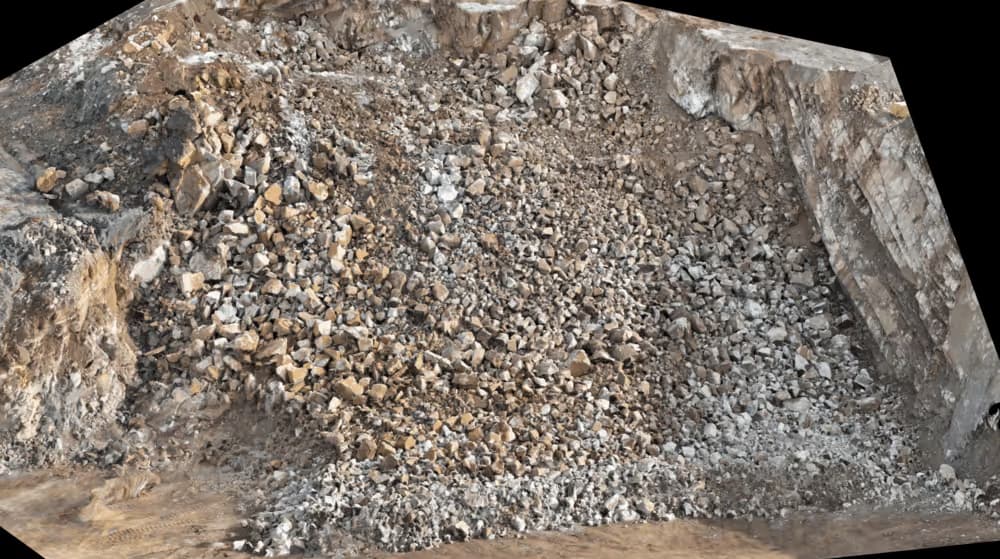
A drone surveys the pile after each blast. A computer vision model finds the rocks on the pile’s surface and measures their size. The team gets a measured size distribution instead of a guess by eye.
Predict what a pattern will do
A machine learning model learns how the pattern, the charge, the timing and the ground affect how the rock breaks. At Tarmac it was built on historical industry data. A quarry’s own blast records can be added to it.
Suggest the next pattern
An optimisation model weighs the cost of drilling and blasting against the cost of loading and hauling, and suggests the pattern it expects to cost least overall.
The quarry and its blasting contractor stay in charge of every blast. Whoever designs the blast treats the suggestion as a starting point. They check it against the face profile, the holes as drilled, vibration limits and the danger zone. Only what they accept goes into the written specification, which the explosives supervisor oversees as usual.
Built with computer vision and industrial optimisation.
Proof
Optimising quarry blast patterns, Tarmac
At one of Tarmac’s flagship quarries, we built the drone survey model, the fragmentation model and the optimisation model in 4.5 months. The project won the Institute of Quarrying’s Emerald Challenge. Better blast patterns cut CO₂ by 21%, cut costs by 6% and put about 10% more rock in each load. Further down the process, secondary breaking fell by 25% and crushing energy by 18%.
Read the case study ›AggCam: crusher conveyor monitoring, Tarmac
Cameras above the conveyors going into and out of the crusher feed a computer vision model that measures rock size and spots downtime. It found crushers running with no rock going through them for 5% to 10% of operating hours. Over a 7-month project it removed 8% of operational downtime and brought 15% more product within specification. Downtime like this was estimated to cost up to £200,000 a year.
Read the case study ›What a project needs
- A blast programme where the pattern can change from one blast to the next, and a blast engineer or contractor who can make that change in the normal design cycle.
- Blast designs and drill logs, with the face or bench and any notes on the geology.
- Some record of what past blasts produced, such as survey photos, secondary breaking hours, load counts, or crusher throughput and power. Gaps are normal.
- Today’s costs to compare against: drilling, blasting, loading and hauling per tonne, or at least secondary breaking hours and crushing energy.
Questions buyers ask
Does a quarry need drones or conveyor cameras already?
No. We would start from the records the quarry already keeps, such as blast designs, drill logs, and crusher and weighbridge data. Drone surveys or cameras are added only where those records can’t show what each blast produced.
How long does it take?
The Tarmac blast work took 4.5 months to reach a working system, and the conveyor camera project ran for 7 months. On a new site, the first step is agreeing which face or crusher to start with, and what data exists.
What if blasting is done by a contractor?
The system suggests a pattern. Whoever draws up the blast specification, quarry staff or the blasting contractor, decides whether to use it. The explosives supervisor oversees the work and the shotfirer fires the shot, as now. The contractor’s blast reports become part of the data.
What about sites with poor connectivity?
Drone images are uploaded after each survey and processed in the cloud, so the site does not need a constant connection. The conveyor model is moving onto small computers beside the crusher (edge devices), so it can run without one.
Does it apply beyond hard rock aggregates?
Our blasting and crushing work so far has been in hard rock aggregates. The same approach would apply wherever a blast feeds a crusher, such as limestone quarries supplying cement and lime, but we would test it on the site’s own data first.
See where specialised AI could create value
The free AI Impact Assessment is a short written report, within 48 hours, on where specialised AI could create value for the business. It draws only on public sources.
Request a free AI Impact Assessment→