

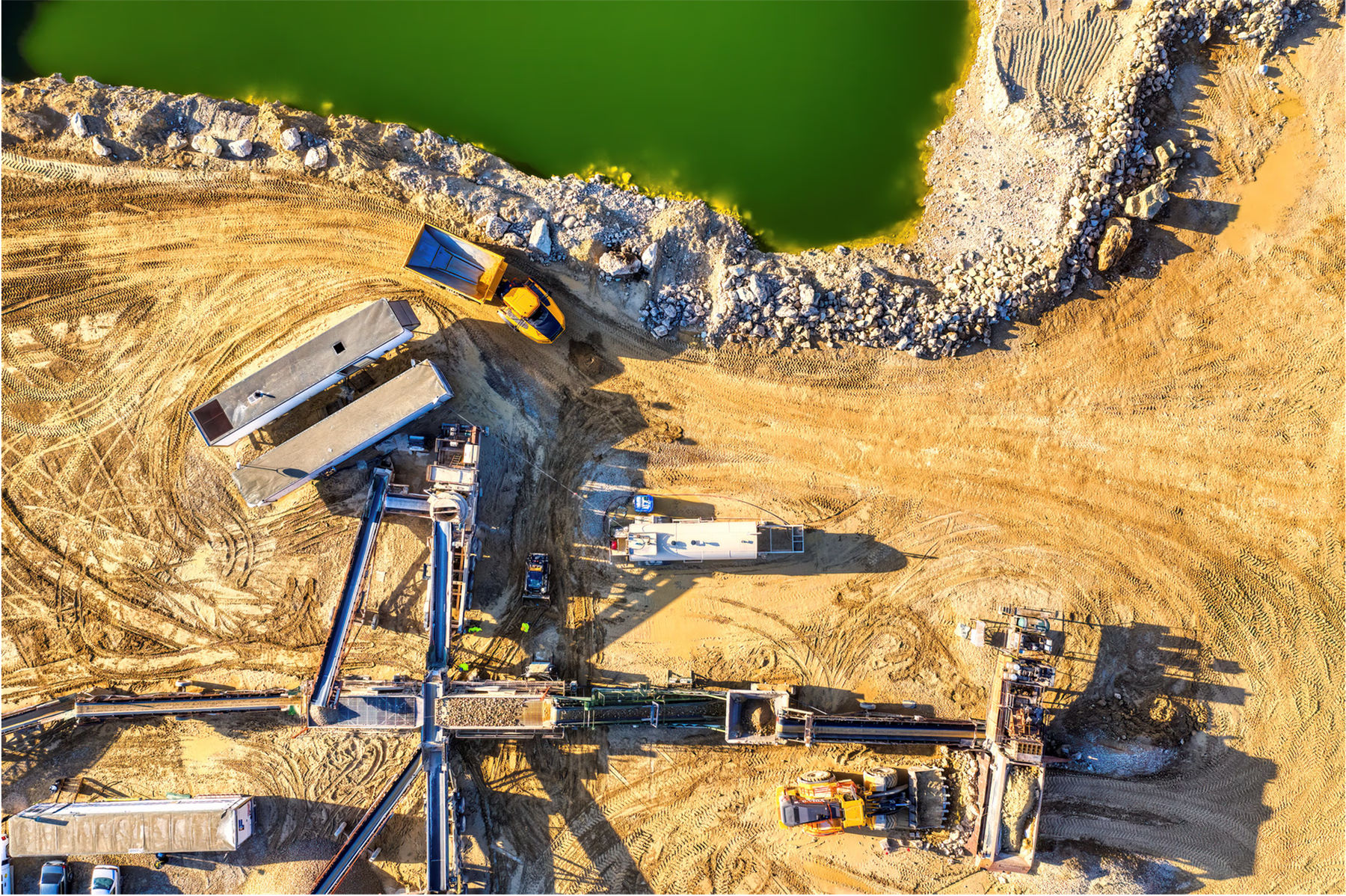
Aggregate production depends on precise control of the crushing process, where rock size, crusher configuration, and real-time monitoring all determine output quality and energy efficiency. Working with Tarmac, New Gradient developed a computer vision system for quarry process optimisation that analyses conveyor imagery in real time, measuring rock sizes and detecting invisible downtimes that were costing up to £200,000 per year.
Invisible inefficiencies in aggregate crushing
Hard rock quarries process material through large crushers to create aggregates for road and construction use. This crushing process involves multiple sequential stages, each significantly energy-intensive and highly sensitive to variations in input rock size and crusher configuration. Incorrect settings and mismatched input rock sizes cause inefficiencies and substantial energy waste.
Continuously measuring rock sizes at high production speeds and promptly detecting processing downtimes are persistent operational challenges. When crushers run but aren't actually processing material, energy is wasted entirely. These inefficiencies were costing up to £200,000 annually in wasted energy and unnecessary CO2 emissions. Without real-time visibility into what's happening on the conveyor belts, operators couldn't respond quickly enough to adjust the process.
Real-time rock size analysis with instance segmentation
As part of Tarmac's IoQ Emerald Challenge-winning initiative, we developed a lightweight deep neural network built for this specific industrial context that analyses high-speed images captured by cameras placed above crusher input and output conveyors. The system uses instance segmentation to identify and measure individual rocks as they pass on the conveyor belt at production speeds, providing continuous monitoring rather than periodic sampling.
By processing imagery in real time, the system gives operators immediate visibility into what's actually flowing through the crushing stages. Initially deployed via cloud computing, the solution identified and eliminated downtime representing 5% to 10% of total operational hours, periods during which crushers were running but not processing material. The system is now transitioning onto edge devices for comprehensive real-time monitoring, enabling operators to dynamically adjust crusher settings based on live rock-size distributions.
8% downtime eliminated, 15% more product in specification
Eliminating previously invisible downtimes has directly increased production throughput, with 15% more product now meeting specification through dynamic crusher adjustment. The 8% reduction in operational downtime translates to significant energy savings and reduced CO2 emissions across the quarry's crushing stages, recovering a substantial portion of the £200,000 annual cost of these inefficiencies.
Real-time rock size analysis enables a feedback loop that wasn't previously possible. Smaller input rock sizes trigger more aggressive crushing configurations, while larger input requires different settings. This continuous optimisation replaced periodic manual sampling, giving operators immediate data rather than estimates.
This work won 1st place in the IoQ Emerald Challenge, demonstrating how industrial computer vision can deliver both economic and environmental benefits in heavy industry. The transition to edge deployment will further enhance capabilities, enabling sub-second response to changing conditions across multiple conveyor monitoring points.