Smart manufacturing systems that monitor, predict, and optimise production in real time.
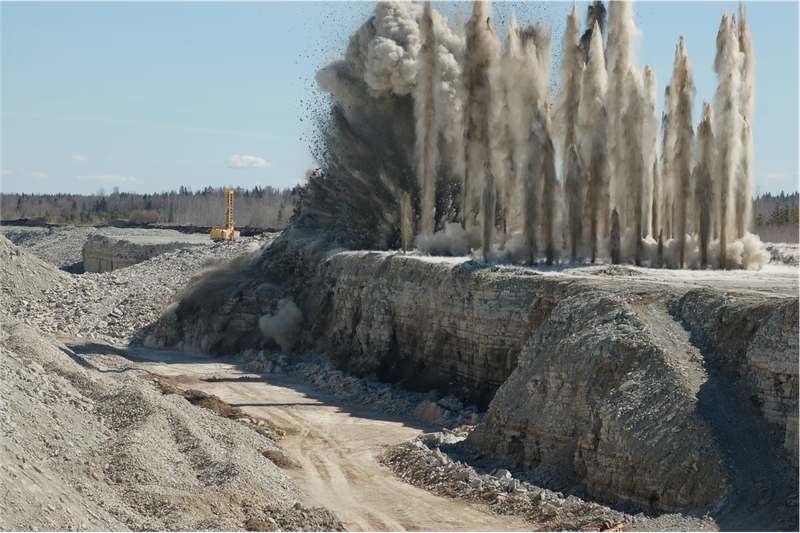
Manufacturing and industrial processes generate enormous volumes of sensor data that typically goes unanalysed beyond basic threshold alerts. Process optimisation with machine learning changes that. Instead of reacting to failures, ML systems ingest live operational data to predict outcomes, detect anomalies before they cause downtime, and continuously adjust control parameters. Our process optimisation work spans closed-loop control for pharmaceutical manufacturing, real-time conveyor monitoring in heavy industry, and blast parameter tuning that cut CO2 emissions by 21%. Each system is built on the specific physics and process knowledge of the domain, not generic anomaly detection. As an AI consultancy, we treat smart manufacturing as an engineering discipline: sensor integration, model architecture, and deployment into live production environments where downtime costs real money.
Predictive maintenance services built on the actual failure modes of specific equipment, not generic vibration thresholds. Models trained on historical sensor data identify degradation patterns weeks before failure. The same approach detects process anomalies that cost production time: crushers running empty, reactions drifting off-specification, throughput dropping without obvious cause.
Continuous process monitoring beyond SCADA dashboards. We fuse data from industrial IoT sensors, cameras, and control systems, then apply ML that detects patterns humans cannot see at production speed. The output is automated control adjustments and operator alerts, not another screen to watch.
Manufacturing efficiency depends on the interaction between dozens of parameters that humans cannot optimise manually. Our ML models learn these multi-variable interactions from production data, identifying the adjustments that move yield upward and waste downward. Production optimisation driven by data, not rules of thumb.
Simulation modelling that mirrors physical processes in software, calibrated against real operational data. We build digital twin services combining physics-based models with data-driven ML for what-if analysis, capacity planning, and training control systems in simulation before deploying to production.
Tell us about your challenge. We’ll tell you which technologies can solve it.
Start a conversation→