

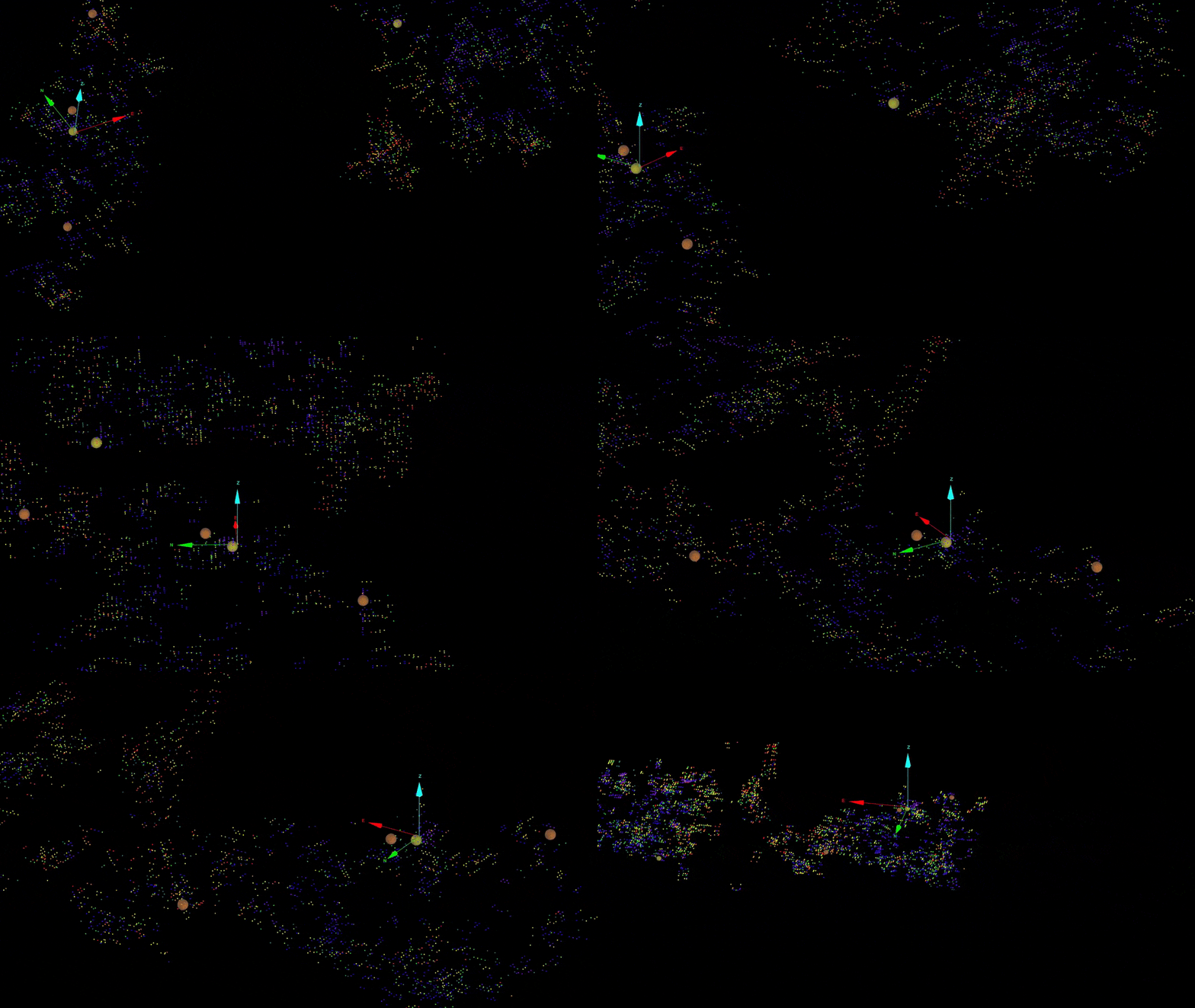
Dundee Precious Metals operates gold and copper mining across multiple international sites. Mineral exploration has a success rate below 1%, with speculative drilling representing one of the industry's largest cost centres. Despite vast geological datasets, traditional interpretation methods struggle to extrapolate patterns into unexplored terrain. New Gradient developed an AI mineral exploration system using 3D scene completion neural networks to predict ore body locations from sparse drill hole data, earning recognition in Dundee's international Future Explorers challenge.
Sub-1% discovery rates and the cost of speculative drilling
Mineral exploration is among the most capital-intensive activities in mining. Predicting new ore deposits has a success rate below 1%, and exploration drilling represents a major cost centre for operations of every scale. Vast amounts of data exist: geological assay results, lithological classifications, mineral concentrations, gravitational surveys, and magnetic measurements. Traditional geological interpretation struggles to combine these heterogeneous sources and extrapolate trends reliably into unexplored areas.
Dundee Precious Metals sought approaches that could improve exploration success rates and reduce the costs of speculative drilling. The question was whether machine learning could identify patterns in complex, multi-dimensional geological data that human experts might miss, then use those patterns to predict high-value drilling targets in unmeasured terrain.
3D masked autoencoders for geological prediction from sparse observations
The system treats mineral exploration as a spatial completion problem: given partial observations from existing drill holes, predict the mineral composition in the spaces between and beyond known data points. We built a novel 3D scene completion deep neural network using sparse transformer networks with a custom 3D Masked Autoencoder (MAE) architecture for patch-masked training.
This technique learns rich representations of geological structures by predicting masked regions from surrounding context. The network processes heterogeneous data sources including drill hole assays, lithological boundaries, and geophysical measurements in a unified framework, combining information that geologists would traditionally interpret separately.
The method is entirely geologically agnostic. It learns patterns directly from data without pre-programmed geological rules or human interpretation of structural features. This means the system adapts to different geological settings and deposit types without manual reconfiguration, making it applicable across diverse mining operations and geological contexts.
0.74 mAP ore prediction accuracy, 40% potential cost reduction
The 3D scene completion network achieved 0.74 weighted mean Average Precision (mAP) at predicting ore class quality across four categories: poor, mild, good, and high-quality ore. This accuracy enables mining operations to prioritise drilling targets with significantly higher confidence than traditional geological interpretation.
By reducing speculative drilling through better target prioritisation, the technology offers potential cost savings of 40% in exploration programmes. The approach earned recognition in Dundee Precious Metals' international Future Explorers challenge, validating purely AI-driven geological prediction against established methods.
The same 3D scene completion methodology extends to any domain requiring spatial prediction from sparse observations, including subsurface resource mapping, groundwater detection, and geotechnical assessment.